Showing posts with label Picture Book. Show all posts

Wednesday, November 18, 2009

Ten Little Ladybugs


by Melanie Gerth

Summary
This board counting book counts backwards from ten to one with a rhyming pattern in order to give children a new outlook on counting. As each number goes down, one of the tactile ladybugs disappears, leaving the children with the new number of ladybugs for the next page. The ladybugs slowly fly away from the group, but at the end instead of saying there are none, it states that they are all home, showing the ten ladybugs in their home on the last page of text.

Discussion
For a preschool classroom or household setting, this book is a wonderful way to help children visualize math concepts such as counting. Seeing the ladybugs disappear before their eyes gives them their first introduction to subtraction, as well as reinforcing their ability to count forward, because they can count the ladybugs on each page with their caregiver or with the teacher in a group. I used this book in a threes classroom at a preschool, and immediately all of the children recognized the book and stated that they had it at home, reinforcing my belief that it is a great book for younger children. The bright colors also attract attention to the pages of the book, with a special focus on the 3D ladybugs.

Gerth, M. (2007). Ten Little Ladybugs. New York: Piggy Toes Press.

Monday, November 2, 2009

Henry's Freedom Box


by Ellen Levine
illustrated by Kadir Nelson

Teacher's Choice 2008
Caldecott Honor Book

Summary
Though he does not know his age, Henry Brown is a young slave working in the house of his master with his mother, brothers and sisters. His mother was very worried about her children being taken from her. When his master was on his deathbed, Henry went to him, hoping that the master would free him, but instead he gave him to his son, making him promise to never tell a lie. Henry was sent to a factory to work for his new master, who was not as kind as his old. One day he met a girl named Nancy, who he married, with the permission of their masters, and they began to have children. Nancy was worried about their children, however, because her master had lost a lot of money. Sure enough, the following day his friend came into the factory and told Henry, "Your wife and children were just sold at the slave market." Henry could not do anything until lunch, when he went to the center of town just as his family was being taken away. Henry no longer had any joy in life, and sought a way to freedom. He decided, "I will mail myself to a place where there are no slaves!" His friend James and a white man named Mr. Smith helped him. Though they wrote "Handle with Care" on the box, Henry was turned all around, but he didn't move for fear someone would hear him. Soon, Henry was in Philadelphia. His new birthday was deemed his day of freedom, March 30, 1849.


Discussion
With a low level vocabulary and a clear engaging text, this book is great for a read aloud or for individual students to read. The subject matter dealt with shows the slave trade from an inside perspective, a perspective not commonly heard. This book does not try to demonize whites, but it clearly shows that slavery was wrong. Henry's Freedom Box would be a great addition to any classroom, especially during Black History Month or any lesson on the Civil War or the Underground Railroad. This was based off of a true story, and the author's note in the back explains that Henry "Box" Brown became one of the most famous runaway slaves after his 27 hour ride from Richmond, Virginia to Philadelphia. The illustrations in the book, done by Kadir Nelson, are incredible, very inviting and rich color schemes, as well as interesting angles. Some pages are very dark, and others have bright light, but all are clear and uncluttered, as can be seen from the examples throughout this blog.


Application
Because this is a Scholastic book, Scholastic's site has a great lesson plan for grades 3-5 when dealing with the Underground Railroad, using this book to help children scaffold their knowledge. (http://www2.scholastic.com/browse/collateral.jsp?id=32442) Also, Henry Brown wrote a narrative of the South and his experience, which can be found here (http://docsouth.unc.edu/neh/brownbox/menu.html). Perhaps an older class could read both and compare and contrast the two different versions.


Levine, E. (2007). Henry's Freedom Box. New York: Scholastic Press.

Tuesday, October 20, 2009

Where the Wild Things Are


by Maurice Sendak

ALA Notable Children's Book 1963
Caldecott Award 1964

Summary
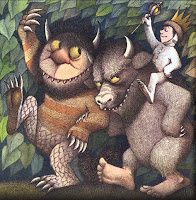
Where the Wild Things Are chronicles one night in Max's life. The story begins with Max traipsing about his house in a wolf suit, making "mischief of one kind and another." Max's disturbance of his house gets him sent to his room to go to bed without supper. As Max closes his eyes while still standing, a forest grew in his room "until his ceiling hung with vines and the walls became the world all around." An ocean came by and picked Max up, and he sailed for over a year until he reached the place where the wild things are. When he got there, the wild things "roared their terrible roars and gnashed their terrible teeth and rolled their terrible eyes and showed their terrible claws." Max, however, was able to control them by staring into their eyes without blinking, and they made him king of all the wild things. For a few pages the wild things and Max have a wild rumpus, which is filled with full page illustrations of them playing on the island. Soon, however, Max becomes lonely and "wanted to be where someone loved him best of all." He smelled good things to eat and decided to give up being king of the wild things. He sailed back home, and upon arriving he found that it was the same night and his dinner was waiting for him. "And it was still hot."

Discussion
Where the Wild Things Are is a world renowned children's book for the imagination that it provokes in children. It is said that children's imaginations run away with them, and this book is the example of one child with a large imagination, that was able to believe he traveled away while angry and became king of the wild things. When I read this book as a child, I always imagined that my brother would become king of the wild things, and then I would have my own peace and quiet. When reading this book to very young children, I have found that they especially like to gnash their teeth and roar with the wild things, as those descriptive words allow for actions along with the book. Where the Wild Things Are could easily be used within a classroom, as well as a bedtime story at home. This week the theme in the preschool that I have been observing at is monsters, and this book is a favorite in the classroom.
As Children's Literature, Briefly states, "good fantasy actually tells the truth about life. It clarifies the human condition and captures the essence of our deepest emotions, dreams, hopes, and fears. If fantasy does not do these things, it fails." Where the Wild Things Are has the great ability to do all of this and more. Max's escape from his punishment allows children to imagine an easy escape and use their imagination to escape their lives. This is a common tool children with difficult childhoods use, as well as all children when they are merely upset with what is going on in their life. However, the story explains to children that even if they were able to go and rule their own colony of wild things, the pull of reality will reach them. It explains the importance of family and love, and that the feeling of being loved is one of the most powerful emotions in the world. No child likes to be lonely, which makes Max's return understandable, and it allows the book to end nicely. Where the Wild Things Are can relate to all children, as well as adults, in that everyone has had feelings of loneliness or a desire to escape their life and be in control in a wholly new place. Although Max is white, I don't believe that this boo marginalizes any one group, as everyone can relate to Max's feelings.

Application
There are hundreds of created lesson plans for PreK-2nd classrooms related to Where the Wild Things Are. A few links are posted to some of the better lesson plans.
This is a lesson plan for a Kindergarten classroom, going through the whole story and pulling out lessons across a variety of learning domains: http://www.easyfunschool.com/article1293.html

Sendak, M. (1988). Where the Wild Things Are. New York: HarperCollins.


Wednesday, October 7, 2009

Alexander and the Terrible, Horrible, No Good, Very Bad Day


by Judith Viorst
illustrated by Ray Cruz

GA State Awards 1972
School Library Journal Best Books 1972

Summary
This book chronicles Alexander's day, which begins with gum in his hair, and tripping on a skateboard. Throughout the book everything seems to go wrong with his day, from not having any prize in his cereal, to being squished in the middle of the car during carpool, to not having his work done during school. After each event, Alexander states "I could tell it was going to be a terrible, horrible, no good, very bad day." He decided that he is going to move to Australia when things go wrong. At the end of the day, Alexander states "It has been a terrible, horrible, no good, very bad day. My mom says some days are like that."

Discussion
This book is illustrated in black and white, which somehow adds to the book though usually it takes away from the story. The book was written from a child's perspective for sure, using language young boys use, and run on sentences and bad grammar. There are so many scenarios in the book that do not go Alexander's way, and it helps to teach children that there will be days that everything seems to go wrong. Even though they are upset, things can get better, and there are days that seems to be "terrible, horrible, no good, very bad days." This book can be used as a conversation between children and their parents about not always getting their way and also about explaining that life isn't always nice and fair. When babysitting, if the child is having a bad day, at the end of it when they select a book to read, many have chosen this one. It may be comforting for kids to know that even know they had a bad day, another child has had a worse day, but that things can get better.
This book was turned into an hour long musical and played in New York City for two years over the holidays. The CD from it can be ordered at www.ducylee.com. Below is a song from the musical, as well as a partial reading of the book from a three and a half year old.


Cruz, R., & Viorst, J. (1972).Alexander and the Terrible, Horrible, No Good, Very Bad Day. New York, NY: Simon & Schuster.

Tuesday, October 6, 2009

Little Polar Bear Finds a Friend


by Hans de Beer


Summary
Lars the polar bear was lonely, and he wished he had a friend to play with. While looking for a friend to play with, he walked into a trap and was shipped into a large warehouse in an airplane. He didn't know what was going on, and ended up getting out of the box while in the storage room. Suddenly, Lars came across a huge walrus who told him they were being taken to a zoo. Neither the walrus or Lars knew what a zoo was, but they decided to start opening all of the other boxed crates, and soon enough all of the animals were free, including a small brown bear named Bea. The walrus helped the animals to find a way to escape, and although the walrus was almost left behind, Bea and Lars went back to make sure he made it out safely. The next morning Lars found Bea crying because her parents were captured too, and he told her she was welcome to go back with him. Bea asks, "But won't your parents be upset because I'm brown?" and Lars answers, "Of course not. Bears are bears!" They find a stream and Lars and Bea rode on the walrus' back, passing a storm and a city, and they finally made it back to the Arctic. Lars' parents were worried about him, but after his return they accepted Bea with open arms, also stating, "Bears are bears!"

Discussion
I understand why this book was a bestseller and has been translated into eight different languages. The illustrations are gorgeous, and they tell the story themselves. Though the story is beautiful, and beautifully written, the message behind the story is even more profound. Using bears, Hans de Beer was able to write a book negating racism and proclaiming equality at a time when the world was in upheaval. This story was published in 1945, before the Affirmative Action movement in the United States, and long before segregation was deemed unconstitutional. Hans de Beer wrote from the Netherlands, but because his books are so colorful and fitting for children all over the world, it has become an international bestseller. He has also written other "Polar Bear" books, this being the third in his series.

Beer, H. d. (1945). Little Polar Bear Finds a Friend. New York City: Northsouth.

Wednesday, September 30, 2009

Busy Farm


Fisher Price Little People book

Summary
This book goes through Farmer Jed's day on the farm, and by doing so chronicles his interactions with the animals. When he encounters each animal, the child is supposed to press the sound button on the right side of the book. Before the press the picture, the text asks "What does the _____say?"

Discussion
This is not what I would call high quality children's literature in the slightest. The text is big enough for children to recognize it is text, and it is a sturdy board book for young children, but the illustrations are not worthy of praise in the slightest. This book was created to help very young children learn their animal sounds through use of manipulative objects in a book, helping to familiarize them with literature. Though the book is not high quality, I feel it would be a helpful addition to a child's play area in a classroom, though definitely should not be used as a read aloud, or even as a nighttime story in one's household.

(2000). Fisher Price Busy Farm. Lincolnwood: International, ltd.

Wednesday, September 23, 2009

Papá and Me

by Arthur Dorros
illustrated by Rudy Gutierrez
*Notable Children's Book 2009
*Pura Belpre Honors Book 2008

Summary
This short picture book describes a boy’s day with his father, focusing on their relationship. The book uses short Spanish phrases in a way to relate to the readers of the book and connect to another culture. The boy sings with his father, walks across the street (holding his hand of course), spends time at the park, and finally ends up with his grandparents on the other side, showing the importance of family and love. The illustrations in the book are gorgeous, as seen below, and they truly succeed in making this book successful and well loved.

Discussion
I was very pleased with this book, both for its multiculturalism and the focus on the relationship of a boy and his father, instead of a boy and his mother. Many books focus on the mother/child relationship instead of the father/child. This book encourages the child to reach for their dreams, and be independent while using their parents’ guidance and help to grow (by way of scaffolding). The Spanish throughout the book could allow a parent to read this book to their child, even if they do not speak English, by allowing their child to read the English parts and they could read the Spanish parts. This book is a perfect at home book, as it is a story about a father and son.

Dorros, A. (2008). Papa and Me. New York: HarperCollins.

Wednesday, September 16, 2009

I Stink!


by Kate and Jim McMullan

*ALA Notable Children's Book 2002
*Boston Globe/Horn Book Honors Award 2002
* Nevada State Award
*New Hampshire State Award
*School Library Journal Best Books 2002

Summary
Narrated by the neighborhood garbage truck, this colorful book with just as colorful and engaging language immediately attracts the interest of children. The garbage truck narrates what he does at night while all the children are sleeping: "Eat your TRASH, that's what. See those bags? I SMELL BREAKFAST!" He uses alliteration and car terms to describe his movements throughout the night while picking up trash, acknowledging the loudness of the trucks: "Did I wake you? Too bad!" In the middle of the book he explains his "alphabet soup", filled with grimy things such as Dirty Diapers, Fishheads, Moldy Meatballs, and Ugly Underpants. On the last two pages he asks, "What's that? You think I STINK? WHOOOOO-WHEE! Do I ever!....But think about it-WITHOUT ME? You're on Mount Trash-o-rama!"

Discussion
This book will leave kids giggling and talking about gross smells. Though obviously fictional, it could open the gate to talking about the necessity of garbage collectors, and it makes the garbage truck less scary, and perhaps more comical. The illustrations paired with the language in this book make it engaging for both adults and children. This was definitely a favorite in my household growing up, and I believe that it will withstand the test of time. Below is a video of a the book being read aloud paired with the wonderful illustrations.

McMullan, J., & McMullan, K. (2002). I Stink!. New York: HarperCollins.

Yellow Umbrella

by Jae Soo Liu
*New York Times Best Illustrated Book Award
*Parent's Choice Silver Honors 1987

Summary
Originally published in South Korea, this book is beautifully illustrated, initially showing a gray page with one yellow umbrella leaving a home. This yellow umbrella is then joined by a blue, then a red, then a green, and so on, and although the grayness stays, the scenery changes. The people are traveling the city and more are joining them along the way. Illustrations are from above, as if someone were in a helicopter flying over the city and photographing the umbrellas. There are raindrops when going over the bridge of water, and though there is a large group of umbrellas, there is still the sole yellow one. The last page shows the umbrellas from a different view, as if the artist were behind all of them. By the height of the umbrellas and the view of the legs underneath, the readers can see that these umbrellas are held by children, and they are all going to school.

Discussion
As a parent I would love to see how my child would narrate this book. There is an accompanying CD with the sounds of gorgeous classical music imitating a rainy day, helping children to get into the mood of reading the book. The bright colors of the umbrellas and their contrast with the grayness of their surroundings helps them to stand out even moreso. This book can provoke discussions with young children about colors and rainy days, and if the child comes to the realization that the umbrellas are held by schoolchildren, families can talk about school. The illustrations really supplement for the lack of a written story, and I honestly believe that a written story would take away from the beauty of these large drawings.

Liu, J., & Sheen, D. I. (2002). Yellow Umbrella (New York Times Best Illustrated Books (Awards)) (New York Times Best Illustrated Books (Awards)). China: Kane/Miller Book Pub.

Wednesday, September 9, 2009

Goose on the Loose


Goose on the Loose
by Phil Roxbee Cox
illustrated by Stephen Cartwright

Summary
A goose rides through town on a red scooter, and as he goes he bumps into various farm animals (rooster, bear, toad, cows etc). The animals convene and decide that something needs to be done about the crazy "goose on the loose", but before they can do anything, the goose lands in the penguin's pool. Throughout the story, each animal says "stop that goose on the loose".

Discussion
The repetition in the story, and the constant rhyme help children to independently read and participate in the story. The back cover of the story analyzes each word in the book and explains a phonetic way of pronunciation, also including the irregular words (comes, everywhere, I, I'll, into, welcome etc). Also, each page has a different farm animal on it, reinforcing knowledge. The bear is named Ted, forcing children to determine what kind of animal it is by looking at it instead of being told directly. The pages fold out, which categorizes this book as an engineered book, as well as the participation part when the children can chant, "goose on the loose!"


Cox, P. R. (2001). Goose on the Loose (Usborne Easy Words to Read). London: Usborne Publishing Ltd.

Brown Bear Brown Bear

Brown Bear, Brown Bear, What Do You See?
by Bill Martin Jr
illustrated by Eric Carle

Summary
This book cycles through different colored animals, beginning with a brown bear. The reader asks "Brown bear brown bear what do you see?" and the brown bear fills in "I see a red bird looking at me." Each page of the book has a new animal, sometimes an odd color (blue horse), and the literacy is constructed in a participation friendly way: "______ _______ what do you see? I see a ______ looking at me." Ultimately, the goldfish sees a teacher looking at him, and the teacher sees children. When the children are asked what they see, they go through all of the animals, thus giving children the opportunity to recall all of the animals they saw during the read aloud.

Discussion
This repetitive entertaining book is a favorite in classrooms and among most young children. When I was in preschool I can remember loving to chant this book with my teachers. The foreshadowing on each age about the upcoming animal allows children to "predict" what animal picture is coming next. This book is perfect for a real aloud, and tests children's memory, imagination, and sequencing ability. The illustrations by Eric Carle are inviting for children, and the odd colored animals provide humor for children (purple cat, blue horse). Children are able to see their own participation in the book as the children on the penultimate page. One could springboard off of this book with felt animals for each animal represented in the book, making puppets, or helping children to construct their own book about things they see.

By clicking on the picture above you can listen to a child reading Brown Bear Brown Bear.

Carle, B., & Martin, E. (. (1992). Brown Bear, Brown Bear, What Do You See?. New York: Henry Holt & Co.

Wednesday, September 2, 2009

Cat's Colors

Cat's Colors
by Jane Cabrera

Summary
This book chronicles a cat, named Cat, when he tries to get readers to guess his favorite color. He asks about green first, noting that it is the color of the grass. Next he asks about pink, the petals of his favorite flowers. Black is explained as the color of the night. Each set of pages is dominated by that color, and the cat is present as well as another animal (cow, bee, bat etc). On the red page the cat is sleeping by the fire in a pose most children recognize as a sleeping kitten. Yellow is described as the sand on the beach. As cats usually get their claws stuck on many things, the purple page is used to address purple yarn. Brown is the color of the earth, where the cat dig holes among worms. Blue is the sky, and white are the clouds. The cat says his favorite color is orange because it is the color of his mother.


Discussion
For children, this book is very helpful when working on color recognition. It can also be used when talking about animals. Since Cat turns out to be a kitten, parents can discuss with their children how Cat is just like them, because cats snuggle just like humans snuggle. Parents can also address the different animals present on each page, and ask their children if they know a bee, a cow, a mouse etc. These animals are seen in a naturally comfortable place for them, so the parents are able to acknowledge an animal's natural habitat. This book could be used for read aloud, but would be much better in a family setting. It should be read to younger children to establish acknowledgment of colors and animals. There is no rhyming in the book, but the bright pages are very attractive to the younger eye.


Cabrera, J. (1997). Cat's Colors. New York: Dial.

Chicka Chicka Boom Boom


Chicka Chicka Boom Boom
by Bill Martin Jr and John Archambault
illustrated by Lois Ehlert

*ALA Notable Children's Book 1989
*Boston Globe/Horn Book Honors Award 1989
*Kentucky State Award
*Parent's Choice Silver Honors 1989

Summary
Using rhyming, the authors tell an interesting story about the various letters of the alphabet all meeting at the top of a coconut tree. As each letter goes to the top of the tree, the question is raised "Chicka chicka boom boom! Will there be enough room?" The letters race to the top of the tree in order (A-B-C etc). As the letters go onto the tree, the illustrations show bright and colorful bolded letters surrounding the tree or on the trunk, helping children to imagine the story. As the last few letters (X-Y-Z) make it up the tree, all the letters come tumbling down in a jumbled mess on the page. The following pages show capital letters with lowercase letters, referring to them as "mamas and papas and uncles and aunts." The letters help each other out of the jumbled mess while the children read the alliteration and onomatopoeia: "M is looped. N is stooped. O is twisted alley-oop. Skit skat skoodle doot. Flip flop flee." as the sun goes down all letters are safely away from the tree, but then the letter A starts the cycle over again.

Discussion
This book is written by Bill Martin Jr, one of the most well known picture book authors. It uses rhyming and alliteration as well as bright and colorful pictures to appeal to young children, even those who cannot read. Children just learning their letters are able to participate with their parents when reading this book if they can recognize the colorful letters on the various pages. The concept of letters racing to the top of a tree amuses many children, and I have never seen this book read with anything less than an overall positive response. On a page where the letters are all tangled, the alliteration and language used coincides with the letters, as they are visibly malformed.

A potential springboard for this book is creating some sort of activity where children are able to be around the letters, perhaps drawing a tree and a few letters on it or, as seen above, using felt or velcro to create a tree trunk and allowing children to stick letters on it.

Archambault, J., & Jr, B. M. (1989). Chicka Chicka Boom Boom. New York: Simon & Schuster Children's Publishing.